


And if dividends are not assumed to be reinvested, are they paid out or are they left in cash? IRR and other assumptions are particularly important on instruments like whole life insurance policies and annuities, where the cash flows can become complex. Recognizing the differences in the assumptions is the only way to compare products accurately. The internal rate of return (IRR) is frequently used by companies to analyze profit centers and decide between capital projects. But this budgeting metric can also help you evaluate certain financial events in your own life, like mortgages and investments.
How do changes in the discount rate affect NPV and IRR?
The internal rate of return (IRR) is the discount rate that makes the net present value (NPV) of all cash flows from a particular project equal to zero. For a project with one initial outlay, the IRR is the discount rate that makes the present value of the future after-tax cash flows equal to the investment outlay. Using IRR to obtain net present value is known as the discounted cash flow method of financial analysis.
Understanding the Internal Rate of Return (IRR) Rule
However, if the IRR is less than the project’s cost of capital, reject the project. The rationale is that you never want to take on a project for your company that returns less money than you can pay to borrow money, that is, the company’s cost of capital. The internal rate of return is a more difficult metric to calculate than net present value. With an Excel spreadsheet, iterating the information and finding the rate of return that sets the project value to $0 is a simple function. Before electronic spreadsheets, financial managers had to calculate it using trial and error, which was a long and complex process. Financial managers and business owners usually like performance measures expressed in percentages instead of dollars.
Example: IRR vs NPV in Capital Budgeting
Due to the reasons outlined above, the real value of the $100 diminishes over time. To evaluate varying cash flow scenarios across different options, we commonly use NPV or IRR. Yes, situations occur where NPV and IRR may suggest different outcomes, often when dealing with unconventional cash flows or varying project sizes. ROI is the percentage increase or decrease of an investment from beginning to end. It is calculated by taking the difference between the current or expected future value and the original beginning value, divided by the original value, and multiplied by 100.
- A handy alternative for some is the good old HP 12c financial calculator, which will fit in a pocket or briefcase.
- In the context of a leveraged buyout (LBO) transaction, the minimum internal rate of return (IRR) is usually 20% for most private equity firms.
- IRR can be useful, however, when comparing projects of equal risk, rather than as a fixed return projection.
- Given that the company’s cost of capital is 10%, management should proceed with Project A and reject Project B.
- Most IRR analyses will be done in conjunction with a view of a company’s weighted average cost of capital (WACC) and NPV calculations.
- The internal rate of return rule can be a useful tool for comparing your different options.
In reality, an investment will usually not have the same rate of return each year. Usually, the actual rate of return that a given investment ends up generating will differ from its estimated IRR. Unlike the IRR, a company’s net present value (NPV) is expressed in a dollar amount. It is the difference between a company’s present value of cash inflows and its present value of cash outflows over a specific period of time. The net present value (NPV) and the internal rate of return (IRR) are both techniques that financial institutions or individuals can use when they are making major investment decisions.
The Formula for IRR
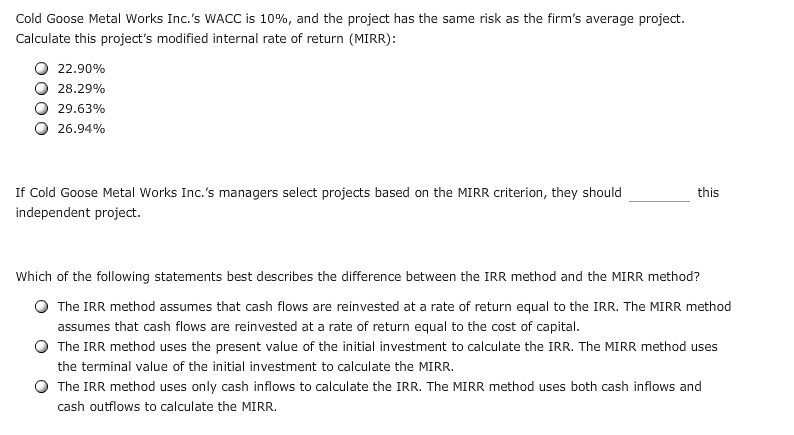
This calculation provides an IRR, indicating the annual growth rate of the investment over the three-year period. IRR does not accurately reflect the scale of the investment, which can be crucial for mutually exclusive projects where size and scale impact decision-making. In the real-world, companies often face decisions between competing projects. A manufacturing firm, for example, might evaluate two new equipment purchases. Whereas NPV provides a direct financial value, IRR expresses this value as an expected annual rate of return.
Based on the completed output for our exercise, we can see the implied IRR and MoM at a Year 5 exit – the standard holding period assumption in most LBO models – is 19.8% and 2.5x, respectively. Since the investment represents an outflow of cash, we’ll place a negative sign in front of the figure in Excel. Regardless, moving expenses the internal rate of return (IRR) and MoM are both different pieces of the same puzzle, and each comes with its respective shortcomings. Furthermore, the hold period can last from five to ten years in the CRE industry, whereas the standard holding period in the private equity industry is between three to eight years.
Another distinction is that CAGR is simple enough that it can be calculated easily. Here is a simple example of an IRR analysis with cash flows that are known and annually periodic (one year apart). Another advantage of using this rule is that it helps companies and investors account for the time value of money (TVM). This is a concept that states that a particular amount of money is worth more now than the same sum in the future.
Overall, while there are some limitations to IRR, it is an industry standard for analyzing capital budgeting projects. The CAGR measures the annual return on an investment over a period of time. The IRR is also an annual rate of return; however, the CAGR typically uses only a beginning and ending value to provide an estimated annual rate of return. Analyses will also typically involve NPV calculations at different assumed discount rates. Generally speaking, the higher an internal rate of return, the more desirable an investment is to undertake.